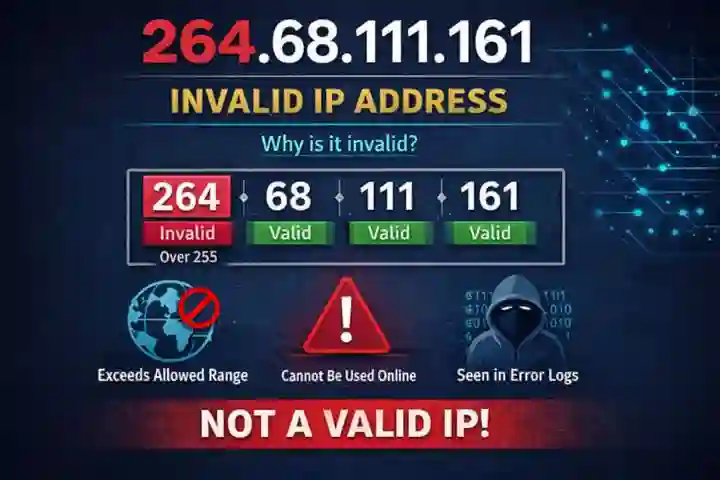
In the modern digital landscape, IP addresses are essential for communication between devices. Every time you browse a website, stream a video, or send a message online, your device relies on an IP address to connect with servers. Occasionally, you may encounter unusual numbers that resemble IP addresses, such as 264.68.111.161.
At first glance, this number appears to be a standard IPv4 address. It follows the familiar format of four numbers separated by dots. However, despite its appearance, 264.68.111.161 is not a valid IP address. This raises several questions: why is it invalid, where does it come from, and should you be concerned if you see it?
This article explores all aspects of this IP-like number in detail, helping you understand its meaning, limitations, and relevance.
Table of Contents
What Is an IP Address?
An IP (Internet Protocol) address is a unique numerical identifier assigned to devices connected to a network. It functions like a digital address, allowing computers, smartphones, and servers to find and communicate with each other.
Whenever you access a website, your device sends a request to a server using an IP address. The server then sends back the requested data so you can view the webpage.
There are two main versions of IP addresses:
IPv4 (Internet Protocol Version 4)
- The most widely used version
- Written as four numbers separated by dots
- Example: 192.168.0.1
IPv6 (Internet Protocol Version 6)
- A newer system designed to support more devices
- Uses a longer and more complex format
This article focuses on IPv4, since 264.68.111.161 resembles this format.
Rules of a Valid IPv4 Address
To understand why this IP is invalid, it is important to know how IPv4 addresses are structured.
Each IPv4 address:
- Contains four numbers (octets)
- Each number must range from 0 to 255
- Uses a total of 32 bits
For example:
- Valid: 8.8.8.8
- Valid: 172.16.1.1
- Invalid: 264.68.111.161
The key rule is that no number can exceed 255.
Why 264.68.111.161 Is Invalid
The address 264.68.111.161 becomes invalid due to a simple violation of IPv4 rules.
Let’s examine it:
| Section | Value | Status |
| First | 264 | Invalid |
| Second | 68 | Valid |
| Third | 111 | Valid |
| Fourth | 161 | Valid |
The issue lies in the first number. Since 264 is greater than 255, it exceeds the allowed limit for IPv4 addresses.
Because of this:
- The address cannot be assigned to any device
- Network systems will reject it
- It cannot be used for communication on the internet
Even though the rest of the numbers are within the correct range, a single invalid value makes the entire address unusable.
Why Does This IP Appear?
If the address is invalid, you might wonder why it appears in various places. There are several possible explanations.
1. Typing Errors
One of the most common reasons is simple human error. A user may accidentally type a number above 255 while entering an IP address.
For example:
- Typing 264 instead of 192
- Mistyping numbers in configuration settings
2. Learning and Demonstration
Invalid IP addresses are often used in educational materials to demonstrate:
- Common mistakes
- Validation rules
- Networking basics
They help learners understand what not to do.
3. Software Testing
Developers and engineers sometimes use invalid IPs to test systems. This allows them to check whether:
- Applications properly validate input
- Errors are handled correctly
- Security filters are working
4. Placeholder Values
In some cases, invalid IP addresses act as placeholders in documentation or code examples. They indicate that a real IP address should be inserted later.
5. Suspicious or Fake Data
Occasionally, unusual IP addresses may appear in misleading or suspicious contexts, such as:
- Fake logs
- Spam messages
- Malformed requests
These are often not real but are included to confuse or bypass simple checks.
Is 264.68.111.161 Dangerous?
The address itself is not harmful. Since it is invalid, it cannot:
- Connect to real servers
- Represent a real device
- Transmit data across networks
However, the situation in which you encounter it may matter.
For example:
- If it appears in logs, it may indicate incorrect input
- If seen in emails, it could be part of suspicious content
- If used in configurations, it may cause errors
So while the IP itself is safe, its presence might signal a problem that needs attention.
Where You Might See This Address
You may encounter 264.68.111.161 in different scenarios:
Server Logs
Sometimes systems record invalid inputs received from users or bots.
Error Messages
Applications may display invalid IPs when incorrect data is entered.
Tutorials and Articles
Writers often use such examples to explain networking concepts.
Testing Environments
Developers may include invalid addresses during debugging and testing.
Common Mistakes That Lead to Invalid IPs
Understanding common errors can help prevent similar issues.
Numbers Beyond the Allowed Range
Using values greater than 255 is the most frequent mistake.
Incorrect Formatting
Missing dots or extra segments can make an IP invalid.
Mixing Address Types
Confusing IPv4 and IPv6 formats can result in incorrect entries.
Manual Entry Errors
Typing mistakes during configuration or setup often lead to invalid addresses.
How to Verify an IP Address
You can easily check whether an IP address is valid by following these steps:
Manual Verification
- Ensure there are four numbers
- Check that each number is between 0 and 255
Using Tools
Various tools and systems can validate IP addresses automatically.
Command Line Testing
Commands like ping can help determine if an address is valid and reachable.
If the IP is invalid, the system will return an error immediately.
Can This IP Be Corrected?
The specific address 264.68.111.161 cannot be fixed as it is, because it violates IPv4 rules. However, you can:
- Double-check for typing errors
- Replace it with a valid IP address
- Use proper validation methods before saving configurations
For example, correcting the first number to a value below 256 would make the address valid.
Importance of Valid IP Addresses
Using valid IP addresses is essential for:
- Proper communication between devices
- Accurate routing of data
- Stable network performance
Invalid addresses can lead to:
- Connection failures
- Configuration errors
- System malfunctions
This is why systems are designed to reject invalid inputs automatically.
Role in Cybersecurity
Even though invalid IPs cannot function, they still have significance in cybersecurity.
Detecting Unusual Activity
Invalid inputs may indicate automated bots or malicious attempts.
Strengthening Validation
Systems must be designed to reject incorrect data to prevent exploitation.
Training and Awareness
They help users and professionals recognize abnormal patterns.
IPv4 Limitations and the Need for IPv6
The restriction of values between 0 and 255 exists because IPv4 uses an 8-bit structure per segment. This allows only 256 possible values.
As the number of internet-connected devices grows, IPv4 addresses are becoming limited. This is why IPv6 was introduced, offering a much larger address space and improved functionality.
Conclusion
The number 264.68.111.161 may look like a typical IP address, but it fails to meet the basic requirements of IPv4 formatting. A single value exceeding the allowed limit makes the entire address invalid and unusable in real-world networks.
Understanding why this happens is important for anyone working with internet technologies. It helps you identify errors, avoid misconfigurations, and improve your knowledge of networking fundamentals.
Whenever you encounter a strange IP address, take a moment to verify it. A small detail—like a number exceeding 255—can make all the difference between a valid connection and a broken one
Also visit : Thisvid.clm